

Although the legislative process may appear mysterious, exclusive or cumbersome, the state legislative process in Texas is widely recognized for its transparency and openness.
In Texas, legislation is not shaped by lawmakers alone. Staff, advocates, agencies, constituents, industry groups and everyday Texans who engage with the process all play a crucial part. Public testimony, stakeholder meetings, negotiations and amendments all influence whether a proposal moves forward, changes form or stalls entirely.
Understanding how the Texas Legislature works includes not only how a bill becomes a law, but the impact that relationships have on the decisions that affect communities, industries and healthcare systems.
It cannot be stressed enough how important the process is – state laws are far-reaching, supersede other laws and must be carefully crafted and vetted. The process’ design is intentional in its effort to promote ideas and suggestions that are gaining consensus. A huge percentage of bills pass with an overwhelming bipartisan majority, leaving few that are decided by contentious party-line votes.
Introduction of Legislation
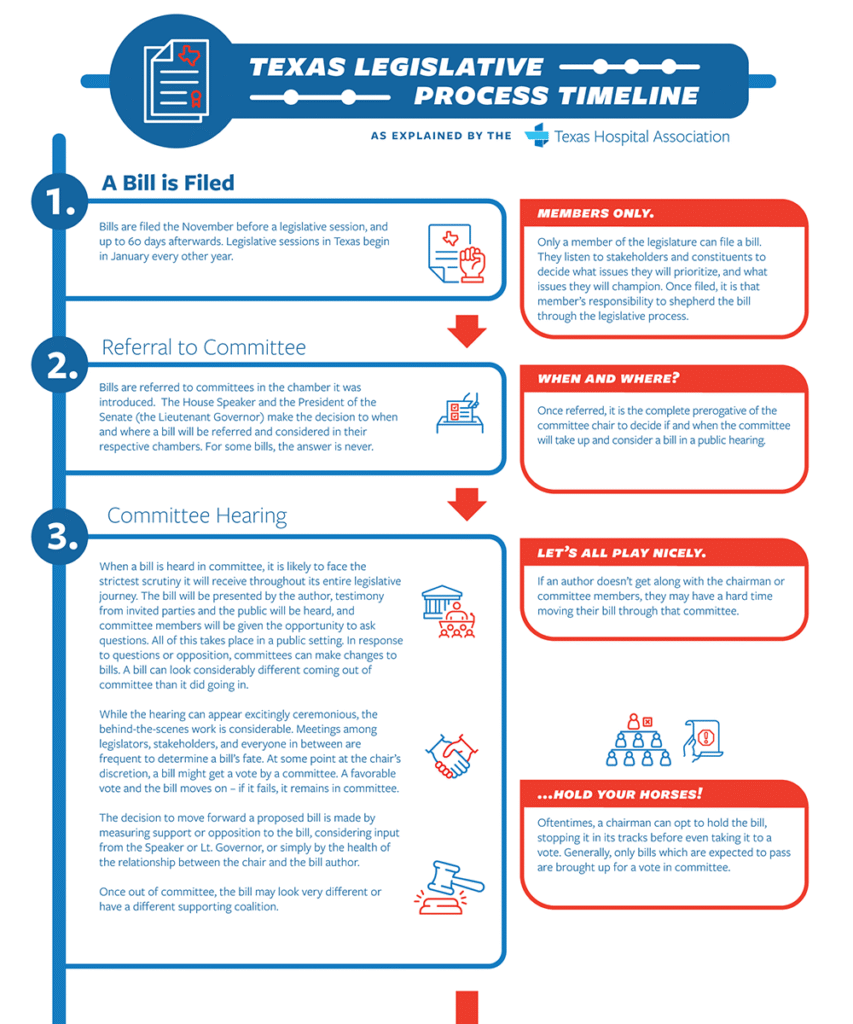
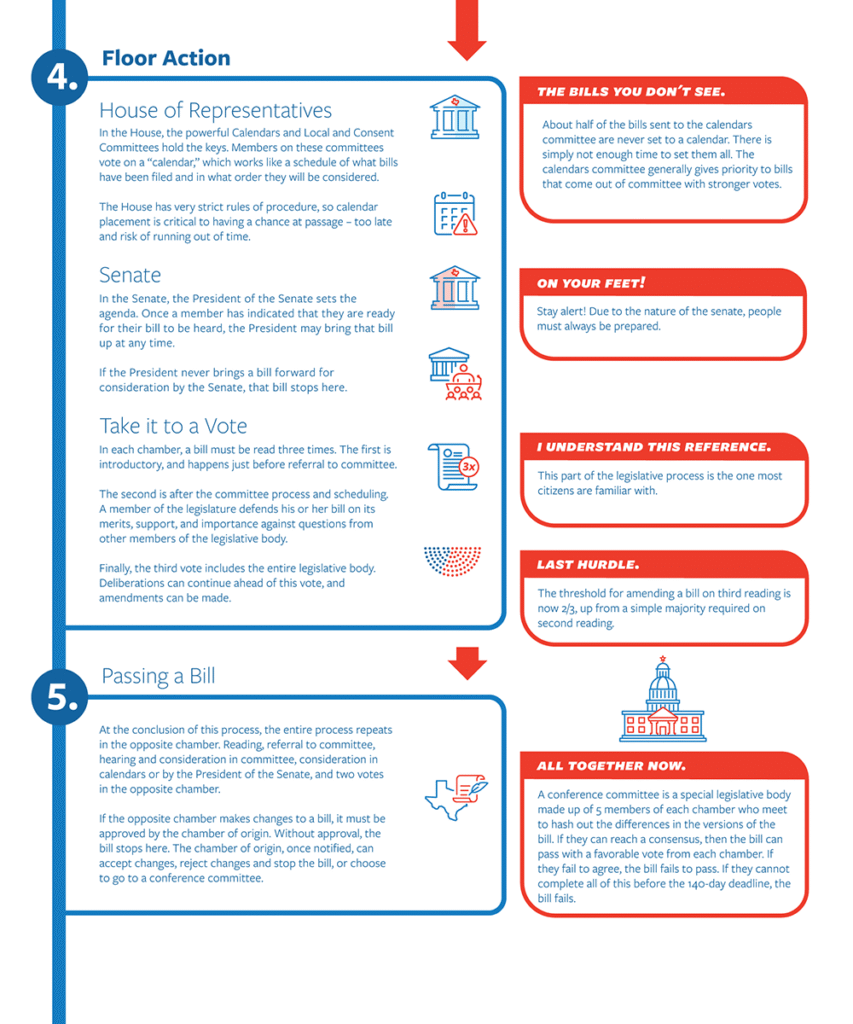
For each action, there’s important details to consider, noted in the red bubbles in the graphic below.
At each stage of the process, there are hurdles that must be overcome. For a proposal to take root, its first step is to be filed.
Governor Action
There are many places to stop a bill and one way out – the only way to successfully pass a bill is to work towards consensus and agreement at every step. A successful bill must have the wherewithal and buy-in from enough stakeholders to survive and be etched into statute. It is incredibly common for bills to take multiple legislative sessions – or several years – to convince enough stakeholders that the reason, purpose and timing is right and become a version ready for passage. Anyone looking to pass a bill in Texas has their work cut out for them, but if the bill passes these intense rounds, it makes it to its destination – the Governor’s desk for signing. Once there, the Governor [GU4.1]has an additional 20 days after final adjournment to exercise veto authority. However, if the Governor doesn’t veto or sign the bill, it automatically passes – many pieces of legislation have come to be this way.
Why the Process Matters
The Texas legislative process is designed to include multiple layers of review, debate and public input. While the system can appear complicated, each stage reflects negotiations between policymakers, stakeholders and everyday Texans who will live under these laws.
For hospitals, businesses, advocacy organizations and communities, understanding the process is essential to participating effectively in policy discussions that shape the future of Texas, including our state’s healthcare system which everyone relies on.
Related articles from The Scope

Facility Fees Keep the Lights On, Not Line Pockets
It’s no secret that the cost of health care has…

Headwinds and Opportunities: Inside THA’s Managed Care & Finance Summit
Texas hospitals are facing constant financial, regulatory and reputational pressures…

Meet THA’s Policy team for the upcoming 90th Legislative Session
During the interim, prior to the 90th legislative session, the…

Clarity is Kindness: Advance Directives Protect Patients, Families
End-of-life care goes beyond the patient; it’s also about the…

Planting the Seeds for 2027: Stay Engaged in the Interim
At Austin’s most well-known building, plenty of important work happens…

Resilience, Results and Readiness: Extending 2025’s Impact for Texas Hospitals
For the Texas Hospital Association and hospitals across Texas, 2025…