
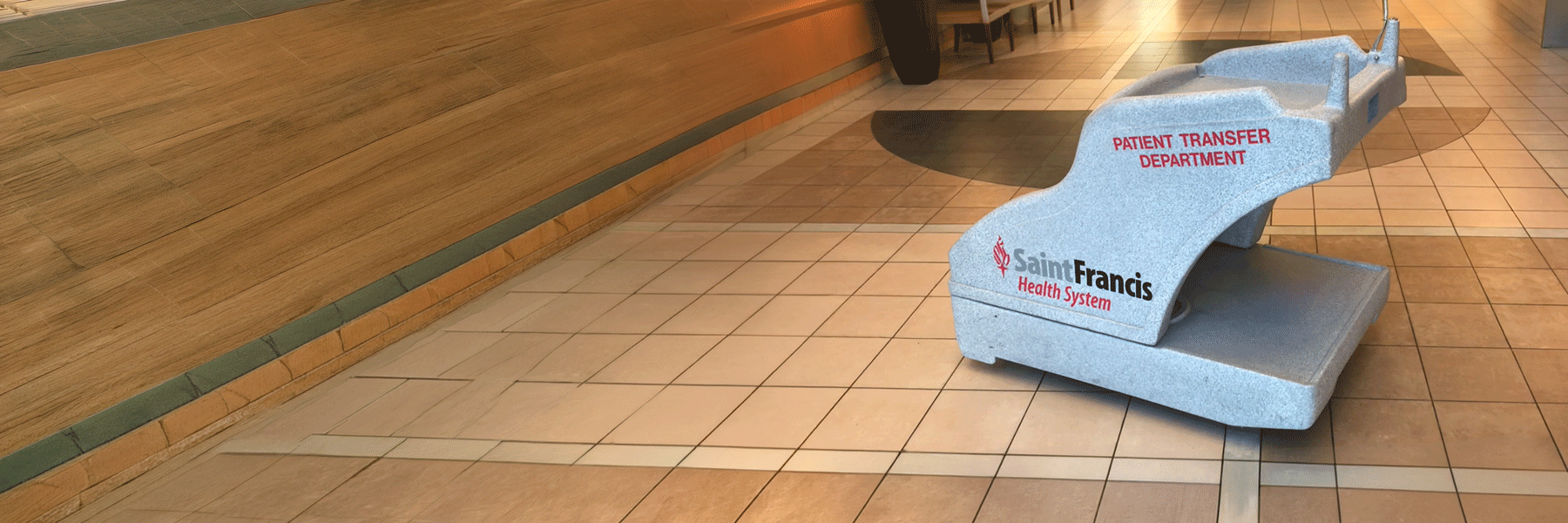
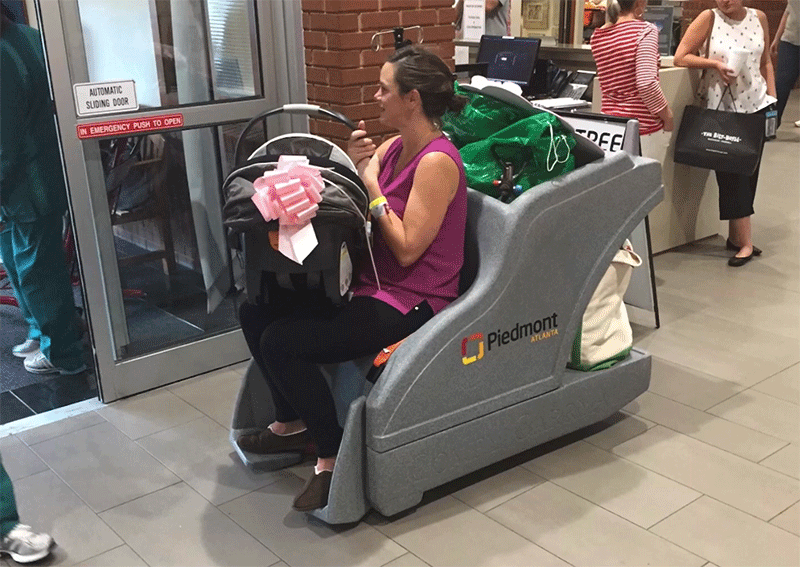
Why should your hospital use CarryAll patient discharge carts? Because they significantly cut time and labor costs, have lots of storage space, don’t need repairs, don’t get stolen, give you a quick return on investment and have a 12-year unconditional warranty.
It has taken some 30+ years and five different models to evolve the patented CarryAll patient discharge cart that now replaces the older model Transcart. While the Transcart design was much more efficient than a wheelchair, a utility cart and two staff members for patient discharges as compared to the CarryAll, it was longer and heavier had a larger turning radius, a limited amount of storage space and no in-motion braking system to slow down on inclines.
The final Transcart design was made thinner and lighter than the previous model because that model didn’t sell. Prior to the final design, the earlier models were made from fiberglass using fiberglass molds that proved to be the wrong material due to chipping of the color coat. There was also a tipping problem when a patient stood up on the molded-in footrest. Ultimately, the material was switched to polyethylene (plastic) using rotational molding and the tipping problem was solved by pouring concrete into two molded-in compartments.
While that solved the tipping problem, it made the cart much heavier and harder to push, even without a patient and their personal items on board. The earlier model of the Transcart was so large and heavy that it didn’t sell, so it was back to the drawing board. That model had to be made thinner and lighter to be a product that met the needs of hospitals.
The first functional model, as mentioned above, was much too large and heavy to meet the needs of hospitals. Several units were produced before it became clear that significant improvements were needed prior to marketing the product to hospitals. The original concept drawing was used to engineer and produce that first functional model, born from the efforts of a couple of people working in a garage in Atlanta to design a cart capable of transporting not only a patient, but also all of their personal belongings, with just one staff member. The CarryAll is the result of 30 years of evolution since that original concept, becoming an efficient, maintenance-free, and cost-effective product.
This article is sponsored by CarryAll.
Related articles from The Scope

Houston Methodist and US Acute Care Solutions Partner for Emergency Medicine Services
Providing high-quality patient care is at the center of every…

Build a Model of Recurring Revenue with CCM
More than 631 rural hospitals, including 76 in Texas, are…

Money Attracts But Fails to Retain New Physicians
A joint study from the Medical Group Management Association (MGMA)…

Contingency Fee Agreements May Be the Right Prescription
The Texas economy is robust, and both private and public…

Addressing The Surge of Texas Data Breach Rates
This article is sponsored by Cynerio. Texas Targeted by HackersIn…

Strengthening Cybersecurity in Health Care: Unveiling Critical Security Gaps
Discover security gaps facing health care organizations, how to fortify…