

Few parts of a medical bill receive as much scrutiny as hospital outpatient payments, also known as facility fees. For patients already facing higher out-of-pocket costs, rising premiums, high deductibles and economic inflation, it’s understandable to wonder: Why am I paying for this?
Reducing healthcare costs isn’t as simple as removing a line from a medical bill. Every healthcare dollar supports something. The question is whether those investments are essential to patient care – and who should ultimately pay for them.
What Are Facility Fees?
Facility fees are one of two key charges related to services; the other being a physician professional fee. The difference isn’t simply an accounting practice. It’s rooted in how healthcare is delivered and regulated in Texas.
In Texas, physicians practicing in hospital outpatient departments generally bill separately from the hospital because state law limits the direct employment of physicians by hospitals. That means one payment compensates the physician for their professional services, while the hospital receives a separate payment to support the care environment itself – that’s the facility fee.
Facility fees financially support everything required to operate an outpatient department beyond the physician’s professional services. e. As Carrie Kroll, THA’s senior vice president of advocacy and public policy explains, “that includes clinical professionals, specialized medical equipment, medications, electronic health records, regulatory compliance, facility maintenance and the infrastructure needed to safely care for patients every day.”
Why Do Hospitals Charge Facility Fees?
Facility fees aren’t optional add-on charges. Federal law governs when hospitals may bill them and requires hospitals to provide notice to patients when applicable. Facility fees only appear on bills after they’ve met specific legal and regulatory requirements. The specific cost is calculated based on the intensity of the care a patient receives in an outpatient facility.
In other words, facility fees support much more than a single office visit. They help fund the people, places and systems that make hospital outpatient care possible. But where exactly does that money actually go?
First, The People
What about seeing a provider via telehealth?
Telehealth still relies on the same infrastructure behind the scenes. Electronic health records, scheduling systems, pharmacy support, cybersecurity and key protocols all remain necessary whether a visit occurs in person or through a screen.
Before a physician ever enters the exam room, dozens of healthcare professionals have already made that visit possible.
Facility fees pay the teams that keep hospital outpatient departments operating every day, including registered nurses, medical assistants, laboratory professionals, imaging technologists, pharmacists, care coordinators, environmental services staff, schedulers, registration personnel and countless others working behind the scenes.
“As the largest employer in many counties across Texas, hospitals employ clinical, specialized and essential staff at market rates, ensuring they can financially support themselves and their families,” Kroll says. “We need qualified people, and we want to compensate them competitively for their skills and allow them to afford the rising costs of living .”
From There, The Building
Why are hospital outpatient departments different?
Independent physician offices and hospital outpatient departments may provide similar services, but they are not regulated the same way. Hospital outpatient departments must comply with more extensive federal and state requirements governing safety, quality, emergency preparedness and hospital operations because they function as part of a licensed hospital.
Patient records, pharmacy systems, laboratory services, quality reporting and clinical oversight must all be integrated into the hospital’s systems and meet the same standards required of the hospital as a whole.
Hospital outpatient sites must be clean, safe and well-maintained clinical environments. That means investing in infection prevention, sterilization, utilities, facility maintenance, security, accessibility, accreditation requirements, quality inspections and spaces designed to safely care for patients with a wide range of medical needs.
Then, The Technology
Texas hospitals invest in advanced technology that many outpatient settings cannot independently support. Facility fees help support advanced imaging equipment, infusion services, patient monitoring systems and equipment that must remain available whether they’re used once or dozens of times in a single day.
Outpatient sites are also often places that administer specialized treatments requiring specific technology or medication, like chemotherapy. Facilities must purchase, safely store and maintain access to these high-cost medications regardless of how frequently they’re used.
“Many of these investments don’t become less expensive simply because fewer patients walk through the door [than on the main campus of hospitals]. Hospitals must maintain the equipment, software and specialized personnel needed to operate it safely regardless of daily patient volume,” says Matt Turner, Ph.D., THA’s senior director of healthcare policy.
As Well As Readiness
Patients understandably expect hospitals to be prepared when something unexpected happens. Even routine outpatient visits can quickly become medical emergencies.
Meeting that expectation means maintaining life-saving medications, crash carts, backup power systems, trained clinical staff, established emergency protocols and immediate access to specialists and hospital resources if a patient’s condition suddenly changes.
What makes funding hospital outpatient departments worth it?
Hospitals and the facilities they own are legally required to be ready to treat any kind of emergency 24/7. That includes the ability to treat complex injuries and address multiple kinds of medical situations simultaneously – all funded only from billing direct patient care.
“Readiness is one of healthcare’s least visible expenses. It’s hard to notice because it’s only visible when those emergencies occur,” adds Turner.
Most patients will never need those resources during a routine visit, but every patient expects them to be there if they do.
And Importantly, Access
Facility fees help hospitals continue operating outpatient clinics close to where patients live, reducing the need to travel long distances for specialty care, diagnostic testing and follow-up appointments. In rural and underserved communities, that support can make the difference between maintaining local services and asking patients to drive hours for care that was once available nearby.
Physician professional fees include payment intended to help cover practice overhead. In many communities, however, that reimbursement alone is not enough to sustain specialty services. Hospital outpatient departments separate those costs into a facility fee, allowing hospitals to invest in clinics that might otherwise be financially unsustainable.
Without hospital investment into outpatient specialty practices, many Texans would go without access to the care they need close to home. Non-profit hospital outpatient departments often provide discounted care for patients in order to serve their communities who have varying healthcare needs.
Many parts of Texas already struggle to preserve access to care – without funding to these outpatient departments, more Texans risk losing essential lifelines.
At the End of the Line
Without facility fees, about 69% of hospitals in Texas would have to close their outpatient clinics. It’s what fuels staff payroll, building maintenance, specialty services, emergency preparedness and importantly, access to care. Following the dollar reveals an important reality: facility fees do more than cover a building. They help fund the resources that allow hospital outpatient departments to deliver care every day.
But that doesn’t change the fact that high out-of-pocket expenses after receiving medical bills can discourage patients from seeking care or contribute to financial hardship. If these services are necessary, why do patients experience them as unexpected costs?
Much of what patients pay out of pocket is driven less by the facility fee itself than by the design of their health insurance benefits. High deductibles, co-insurance and other cost-sharing requirements often determine what patients ultimately owe, even when the underlying services are medically necessary. Hospitals have no ability to direct how health insurance companies and employers structure their health plans, covered benefits and patient cost-sharing.
Healthcare affordability and transparency matter. Patients deserve to understand what they’re paying for and to have access to affordable care.
Facility fees are not junk fees; they pay for critical health care infrastructure. Understanding what they support can help inform conversations about affordability, access and the resources required to deliver care across Texas.
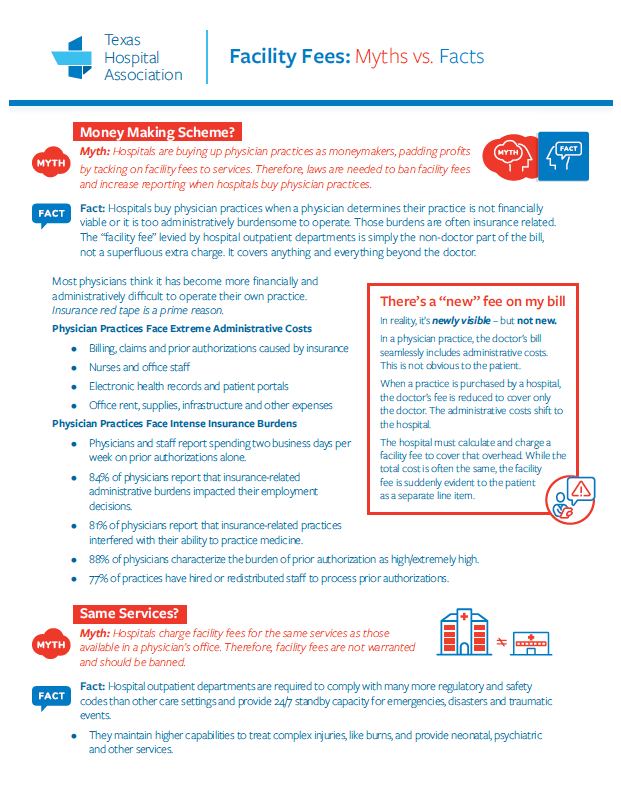
Facility Fees: Myths vs. Facts White Paper
Related articles from The Scope

The Negative Impact of Medical Credit Cards and Patient Interest Charges
This article is sponsored by AblePay. When the Consumer Financial…

A Threat to Hospital Payments is a Threat to Patient Care
Texas hospitals are mission-driven organizations dedicated to healing patients. However,…

Texas Hospitals are Reclaiming Reality in 2024
Three years of saving lives, elevated personal risk and unprecedented…

Build a Model of Recurring Revenue with CCM
More than 631 rural hospitals, including 76 in Texas, are…

Contingency Fee Agreements May Be the Right Prescription
The Texas economy is robust, and both private and public…
Fact: The Pandemic Had a Staggering Financial Toll on Texas Hospitals
Contrary to popular belief, hospitals did not get rich off…