

💡 What’s Happening?
New reports on the financial health of patients and hospitals over the last year are rolling in, and three trends are emerging which are putting increasing pressure on Texas hospitals.
First, hospital operating costs continue to rise; second, demand for care remains strong. Finally, Marketplace coverage is beginning to decline after several years of growth. Although Marketplace sign-ups remained high, fewer Texans completed enrollment by paying their first premium than last year, marking the first year-over-year decline since 2019.
It’s no secret that healthcare costs are a top concern across the economy, and individually, these trends tell part of that story. But put together, they offer a clearer picture of the financial environment hospitals are navigating while continuing to be a staple of care and business for communities statewide.
📈 Rising Costs
Hospital expenses continue to outpace inflation, driven largely by labor and pharmaceutical costs. There’s a consistent effort to balance quality of services and professionals with cost. However, recruiting and retaining a skilled workforce remains expensive and challenging. Meanwhile, drug spending continues to grow because of both higher prices and increased utilization as the population grows. Hospitals have worked to improve efficiency yet many of these cost drivers remain outside of their control.
Hospitals rely on income from health payers to keep pace with rising prices, a strained revenue source as insurers tighten contracts with health organizations, either through massive cuts in funding or restrictive business practices.
“1. Hospital performance remains under pressure in 2026. Mixed performance on key volume indicators, staffing challenges, and expense growth continue to pressure hospital operations, reinforcing the need for focused prioritization and strategic planning.
2. Expense growth continues to outpace inflation. Drug and labor expense remains a key contributor to expense growth, driven by both cost and utilization as the population ages, underscoring the importance of strategic spend management across the board.
3. Payer mix continues to erode. Year-over-year climbs in bad debt and charity care reflect broader shifts in payer mix, shifts in coverage, and growth in uninsured populations, requiring hospitals to proactively adapt and manage long-term revenue risks.”
Kaufman Hall: National Hospital Flash Report (Key Takeaways)
“Drug costs are emerging as one of hospitals’ fastest-growing expense categories, outpacing labor and other nonlabor costs as organizations continue to navigate a challenging financial environment, according to Kaufman Hall’s latest “National Hospital Flash Report.” …Among facilities with more than 500 beds, drug expense per adjusted discharge climbed 12.3% year over year and 33.6% compared to 2023. Drug expense per calendar day increased 12% from the prior year and 43.3% over the three-year period, making it the fastest-growing major expense category for large hospitals.”
Becker’s Hospital Review: Drug costs are becoming hospitals’ fastest-growing financial threat
🩺 Continued Demand
Even years after the COVID-19 bubble, demand for healthcare is on the rise. While patient volumes vary across different service lines, Texans continue relying on hospitals for their emergency, specialized and complex care every day.
Texas has the second largest population of people 60 years of age and older in the United States and shares a concerning number of higher-acuity cases. The fact is that it costs more to take care of sicker patients. Specifically in Texas, where the reimbursement rate for Medicaid patients typically does not cover the full cost of care and treatment is provided at a loss; that loss is magnified when applied to sicker, higher cost patients.
“The influx of elderly Americans will put unprecedented strain on healthcare systems. One recent study projects that ‘of the population 50 years and older, the number with at least one chronic disease is estimated to increase by 99.5% … to 142.66 million by 2050.’ Demands and costs for the next age bracket are even more problematic. The Centers for Medicare & Medicaid Services found that per capita costs for those 85 or older are twice as high as for those 65 to 84.
According to 2019 data from the Centers for Disease Control, more than half of 18-to 34-year-olds have at least one diagnosed chronic condition, and roughly one quarter have at least two. …America’s adults are chronically ill as well. As each demographic bracket ages and becomes even less healthy, physician demand will continue to increase.”
Cicero Institute: Demand for Healthcare is About to Skyrocket
📉 Shifting Coverage
The financial picture becomes even more complicated when fewer patients have adequate health coverage.
Texas remains one of the nation’s largest Affordable Care Act marketplaces, with millions of Texans selecting coverage during the most recent open enrollment period – second only to Florida. The financial picture becomes even more complicated when fewer patients have adequate health coverage. However, new CMS data show that fewer Texans followed through by paying their first month’s premium, resulting in fewer Texans obtaining Marketplace coverage than the year before – the state’s first year-over-year decline since 2019. The decline follows the expiration of enhanced federal premium tax credits at the start of this year.
Even modest shifts in coverage can have an outsized impact on Texas patients, as they add to the growing coverage instability or the shift to becoming uninsured. When Texans lack coverage, hospitals are put under significant strain. Hospitals are required to treat anyone who comes in through the door, regardless of coverage. Providing care to uninsured and underinsured patients often results in unpaid bills and financial hardship for hospitals.
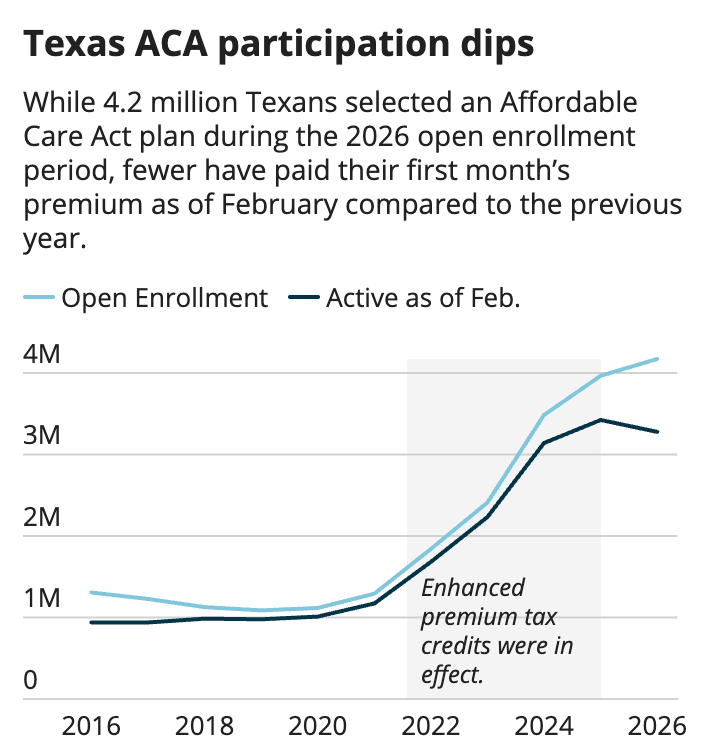
“ACA enrollment grew from about 1.3 million Texans in 2021 to nearly 4 million in 2025, the last year of the enhanced subsidies, and experienced a record high this year of 4.17 million during open enrollment. But each year, the number of enrollees who effectuate coverage by making a payment is smaller than those who initially sign up. …This year, 79% of enrollees effectuated their coverage, meaning that nearly 900,000 of the 4.17 million Texans who selected Affordable Care Act plans during open enrollment had canceled their plan or not paid after the first premium payment deadline.”
The Texas Tribune: Texas’ ACA enrollment shrinks by 4% after tax credit expiration, new federal data shows
💭 What Does This Mean?
Higher operating costs become harder to absorb when more patients lack adequate coverage. Continued demand means hospitals cannot simply reduce services to cut expenses. And financial pressures can make it more difficult to recruit staff, invest in technology, expand access or sustain services in communities that depend on them.
⭐ There’s no question as to whether hospitals are under pressure. The concern is how long they can continue absorbing it.
📖 Learn More
What’s Driving the Cost of Hospital Care?
Insurance companies shift health care costs to patients
Hospitals Want to Bring Costs and Prices Down. Let’s Attack the Root Causes of the Problem.
How Are Texas Hospitals Approaching Demand in the Healthcare Workforce?
